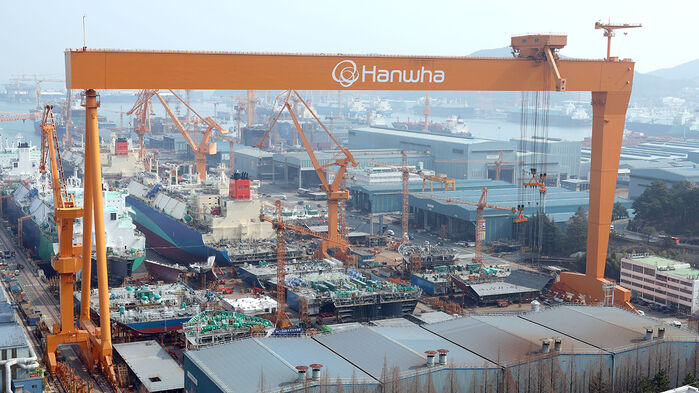
▲ A view of the Hanwha Ocean shipyard in Geoje.
The Ministry of Employment and Labor stated that the National Labor Relations Commission's (NLRC) recent decision recognizing Hanwha Ocean as an employer for the union of its in-house catering subcontractor, Weliv, does not contradict the ministry's existing interpretation guidelines on the "Yellow Envelope Act."
During a press briefing held today (June 22) to mark 100 days since the implementation of the Yellow Envelope Act, the Labor Ministry explained, "This case is an instance where the employer status of the prime contractor was recognized specifically regarding industrial safety and working environment issues," adding, "It does not conflict with our existing interpretation guidelines."
Previously, the NLRC ruled in favor of the union on June 15 in a retrial regarding the public notice of a bargaining unit between Hanwha Ocean and the Weliv branch of the Korean Metal Workers' Union.
The commission determined that Hanwha Ocean holds employer status over the Weliv union and must publicly announce that the company has received a bargaining request from the union.
In response, the business community has argued that this decision conflicts with the interpretation guidelines established by the Labor Ministry prior to the enforcement of the Yellow Envelope Act.
The guidelines state that for in-house subcontractors performing cooking and serving duties in factory cafeterias, a prime contractor's request to align meal times with work schedules constitutes "general instructions" within the scope of management under a subcontracting agreement. The guidelines further explain that it is difficult to view this as the prime contractor structurally controlling working conditions.
However, the Labor Ministry drew a line, stating that this NLRC decision was not about such general work instructions, but rather a judgment on whether the prime contractor exerts substantial control and management over "industrial safety and the working environment."
A Labor Ministry official explained, "The NLRC recognized employer status based on whether the prime contractor has the authority and responsibility to improve the working environment," adding, "The content and nature of this case differ from the examples of general directive rights mentioned in the interpretation guidelines."
In fact, the Labor Ministry's interpretation guidelines also present the authority and budget to decide on the improvement, scope, and timing of facilities related to noise, odors, dust, and air conditioning as factors that can lead to the recognition of employer status regarding the working environment.
The Labor Ministry views the recent NLRC judgment as having been made in accordance with these criteria.
(Photo: Yonhap News)
※ Please note: This article was translated by AI and may contain errors.